




Washington Wants One Rulebook for AI, but States Are Already Writing Their Own
Go Right News Shared by Peter Boykin
American Political Commentator | Citizen Journalist | Activist | Constitutionalist for Liberty
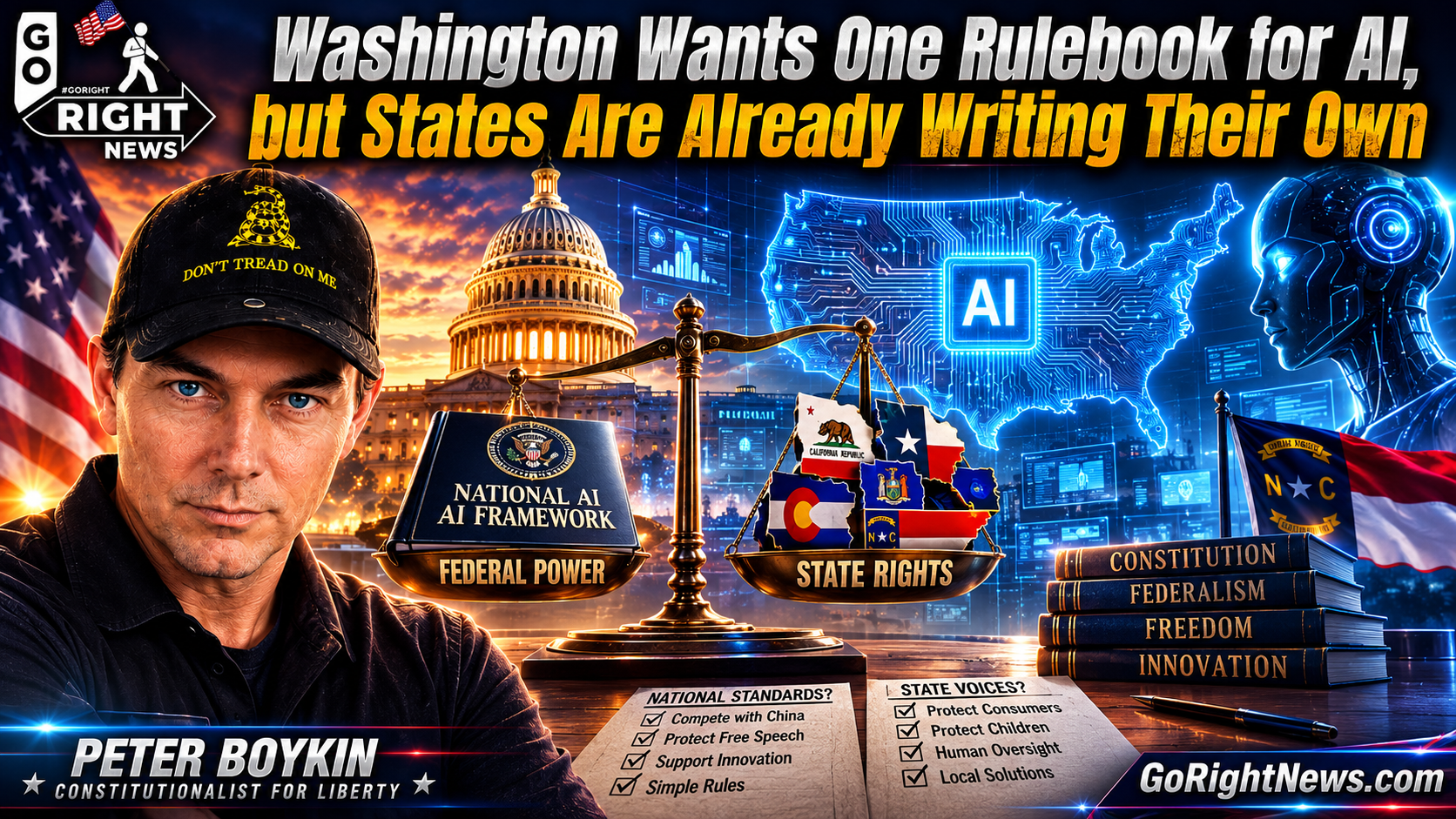
Trump Wants One AI Rulebook for America, but States Are Testing How Far Washington Can Push Them Aside
Go Right News Shared by Peter Boykin
American Political Commentator | Citizen Journalist | Activist | Constitutionalist for Liberty
Artificial intelligence is becoming one of the most consequential federalism fights in modern America.
President Donald Trump wants the United States to dominate artificial intelligence, and his administration argues that American companies cannot win a global technology race while navigating dozens of conflicting state regulatory systems. Executive Order 14365 established a federal policy favoring a minimally burdensome national AI framework and directed the Justice Department to create an AI Litigation Task Force specifically empowered to challenge state laws the administration believes are unconstitutional, preempted by federal law or otherwise unlawful. (The White House)
The White House has since taken an important additional step. In March, Trump released a national AI legislative framework and called on Congress to establish more uniform federal rules involving child protection, intellectual property, free speech, innovation, energy and workforce development. The administration argues that a patchwork of state laws could undermine American innovation and weaken the country’s ability to compete internationally. (The White House)
The states, however, are not waiting for Washington.
California, Colorado, New York, Texas and other states have developed their own rules governing high-risk AI systems, transparency, automated decisions and consumer protection. North Carolina lawmakers are considering their own AI measures involving healthcare, insurance, employment, education, elections and other consequential uses of automated technology. (Reuters)
The conflict has also moved beyond political speeches.
The Justice Department intervened in xAI’s challenge to Colorado’s original artificial intelligence law, arguing that the state’s algorithmic discrimination provisions violated the Equal Protection Clause of the Fourteenth Amendment. Colorado later repealed and replaced that framework with a narrower automated decision-making law. (Department of Justice)
America is therefore approaching a constitutional question much larger than whether artificial intelligence is good, bad, dangerous or revolutionary.
If AI crosses every state line, who gets to write the rules: Congress, the states, the president, or some combination of all three?
Trump’s Strongest Argument: Fifty AI Rulebooks Can Become a Tax on Innovation
The administration’s basic economic argument deserves to be taken seriously.
Artificial intelligence does not stop operating when someone crosses a state border. A model developed in North Carolina can serve customers in California, Texas, Colorado and New York almost instantaneously.
That creates a regulatory problem very different from many traditional state-regulated industries.
A national AI company could face one disclosure requirement in California, another discrimination standard in Colorado, a different consumer protection rule in Texas and still another reporting obligation in New York.
Trump’s executive order argues that such a patchwork creates especially serious burdens for startups and smaller companies. (The White House)
That point should concern conservatives who value competition.
A trillion-dollar technology corporation can employ armies of lawyers, lobbyists, compliance officers and policy specialists.
A startup may have ten employees.
If entering the AI market requires complying with dozens of complicated regulatory regimes before a developer can sell a product nationally, regulation can unintentionally strengthen the very technology giants lawmakers claim they want to restrain.
The big corporation absorbs the cost.
The smaller competitor never gets started.
There is also a legitimate national competitiveness question. The United States is competing with China and other countries for technological leadership, economic investment, military advantage and influence over the standards that will shape artificial intelligence around the world.
Trump is right that America should not casually regulate itself out of that race.
But economic convenience does not answer the entire constitutional question.
A policy can make economic sense and still require Congress rather than presidential action.
Washington Has Moved From Complaining About State Laws to Challenging Them
Executive Order 14365 is important because it does more than express presidential preferences.
It created a mechanism for federal action.
The order directed the attorney general to establish an AI Litigation Task Force whose sole responsibility is challenging state AI laws that conflict with the administration’s national policy. The order specifically contemplates arguments involving interstate commerce, federal preemption and other constitutional or statutory grounds. (The White House)
The order also directs the Commerce Department to evaluate state AI laws and examines whether certain federal funding mechanisms can be used to discourage state policies Washington considers excessively restrictive. It further calls on the Federal Trade Commission and Federal Communications Commission to examine areas where federal standards might displace conflicting state requirements. (The White House)
That is a substantial use of federal power.
Some of it may be entirely lawful.
If Congress has enacted a federal law that preempts a conflicting state requirement, federal law wins under the Supremacy Clause.
If a state law violates the First Amendment, Equal Protection Clause or another constitutional protection, courts can strike it down.
If a state attempts to regulate interstate commerce in a manner forbidden by the Constitution, federal courts can resolve that dispute.
Those are normal features of constitutional government.
But there is a meaningful difference between challenging an unlawful state law and treating presidential policy preferences as if they were federal legislation.
That distinction should remain visible throughout this debate.
Colorado Became the First Major Stress Test
Colorado provides a good example of why the distinction matters.
Its original Artificial Intelligence Act created obligations for developers and deployers of high-risk AI systems used in consequential decisions involving areas such as employment, housing, education, healthcare and finance.
The Justice Department moved to intervene in xAI’s lawsuit challenging that law. DOJ argued that Colorado’s algorithmic discrimination framework violated equal protection because it attempted to prevent certain unintended discriminatory outcomes while providing protections for some measures intended to advance diversity or address historical discrimination. (Department of Justice)
Colorado subsequently changed course.
In May, lawmakers enacted SB 26-189, which repealed and reenacted the state’s earlier framework with a narrower system governing automated decision-making technology in consequential decisions. Governor Jared Polis signed the replacement on May 14. (Colorado General Assembly)
The new Colorado law does not mean the federal government has established a general constitutional right to preempt state AI policy.
It does demonstrate that the Trump administration’s strategy is already influencing the regulatory environment.
States now have to consider not only what AI policy they want, but whether the Justice Department may challenge it.
That pressure will likely influence legislation far beyond Colorado.
The First Amendment May Become the Biggest AI Fight of All
The most important long-term constitutional question may not be federalism.
It may be speech.
Trump’s executive order directs federal officials to examine state laws that could require AI developers to alter truthful outputs or impose requirements that conflict with First Amendment protections. (The White House)
That issue deserves serious attention from both conservatives and civil libertarians.
Artificial intelligence increasingly influences what Americans read, research, write and learn.
People are beginning to use AI systems in ways that once belonged to search engines, encyclopedias, news aggregators, editors and research assistants.
Government control over AI output could therefore become government influence over public discourse.
A state should not be able to command an AI model to promote progressive political orthodoxy.
Texas should not be able to require conservative political orthodoxy.
Washington should not be able to create a national political orthodoxy either.
At the same time, not every regulation affecting AI speech is censorship.
Requiring a company to disclose that a consumer is interacting with artificial intelligence is not necessarily the same as ordering the AI what political opinion to express.
Requiring disclosure of safety testing is different from compelling ideological speech.
Requiring transparency when an automated system helps make a decision about insurance, employment or government benefits can serve legitimate consumer interests.
Courts are going to have to distinguish genuine compelled speech from ordinary commercial and consumer regulation.
That line will matter enormously.
North Carolina Is Already Writing Its Own AI Rules
North Carolina has a direct stake in this fight.
House Bill 565, titled Limit Use of AI Medicaid/Commercial Insurance, would place limits on the use of artificial intelligence in healthcare claims and utilization review. The House passed the legislation 110-1, and the bill has since been rewritten through Senate committees. Its latest action was referral to the Senate Rules and Operations Committee on June 23. (North Carolina General Assembly)
The legislation would prohibit insurers and Medicaid prepaid health plans from using AI as the sole basis for denying certain utilization-review determinations. It also addresses AI use in healthcare billing and coding. (NCGA Dashboard)
North Carolina lawmakers have also introduced House Bill 1161, the Omnibus Artificial Intelligence Protections bill. That proposal reaches into education, employment, elections, courts, insurance and consumer protection. It remains in the House committee process. (North Carolina General Assembly)
House Resolution 1177 proposes a Consumer Protection AI Bill of Rights, while other measures involve social media, healthcare and automated systems. (North Carolina General Assembly)
These proposals are important because they demonstrate what federalism actually looks like.
Raleigh is not simply trying to regulate abstract computer code.
North Carolina lawmakers are asking questions such as whether an insurance company should be allowed to let a machine make a consequential healthcare decision without meaningful human review.
Those are traditional areas of state concern.
If Washington eventually preempts broad categories of state AI regulation, North Carolina could lose authority over policies its own lawmakers believe are necessary to protect residents.
That possibility deserves more attention than the usual partisan framing.
Even Trump’s Own Order Preserves a State Role
The White House itself implicitly acknowledges that federal AI preemption cannot simply mean eliminating state authority.
Executive Order 14365 says the administration’s proposed federal legislation should not automatically preempt otherwise lawful state laws concerning child safety, AI compute and data center infrastructure, state government procurement and other areas the administration may identify. (The White House)
That is an important concession.
The real debate is therefore not:
Can states regulate AI?
Clearly, states retain some authority.
The actual question is:
Which subjects require national uniformity, and which should remain open to state experimentation?
That is a much harder question.
It is also exactly the kind of question Congress was created to answer.
Congress Is the Missing Branch in Too Much of This Fight
If America genuinely needs one national AI framework, Congress has enormous constitutional authority to create it.
AI systems engaged in national commerce are obvious candidates for federal regulation under the Commerce Clause.
Congress can establish national standards.
Congress can create a federal baseline.
Congress can expressly preempt conflicting state laws where constitutionally permitted.
Congress can preserve state authority in specified areas.
Congress can establish privacy and transparency protections.
Congress can protect children.
Congress can protect free speech.
Congress can address copyright and intellectual property.
Most importantly, members of Congress have to vote.
That gives the public accountability.
The White House recognized this reality when it released its national legislative framework in March and explicitly called on Congress to transform the administration’s objectives into legislation. (The White House)
There are already competing approaches on Capitol Hill.
House Bill 5388, the American Artificial Intelligence Leadership and Uniformity Act, proposes a national AI framework and a temporary moratorium preempting certain state laws restricting AI systems involved in interstate commerce. It remains an introduced bill and has not passed Congress. (Congress.gov)
Senate Bill 3557 takes almost the opposite position. The States’ Right to Regulate AI Act would prohibit federal funding from being used to implement Trump’s December executive order. It too remains in committee and has not become law. (Congress.gov)
That disagreement is healthy.
Congress should have this argument publicly rather than leaving national AI policy to a slow accumulation of executive orders, agency actions and lawsuits.
Federalism Is Still a Feature, even in the Digital Economy
There is a conservative argument for allowing states to experiment.
States have historically served as laboratories of government.
One state may discover an effective way to stop AI-enabled consumer fraud.
Another may create rules that sound good but become an expensive bureaucratic failure.
Another may develop a strong model for human review of automated insurance decisions.
Another may discover that its regulations unintentionally drive startups away.
Other states can learn from those experiments.
Federalism limits the geographic damage caused by bad policy.
If North Carolina passes a bad AI law, the mistake does not automatically govern California, Texas and New York.
If Washington passes a bad national AI law, the whole country receives the mistake at the same time.
There is also regulatory competition.
If one state makes technological development nearly impossible, businesses may move.
If another creates predictable rules that protect consumers while encouraging investment, companies may choose to build there.
That is not an argument against federal law.
Artificial intelligence clearly presents interstate issues.
It is an argument against assuming every technological problem has only one acceptable regulator.
The Hardest Problem Is That One State Can Sometimes Regulate the Entire Country
The strongest argument against a state-by-state model is practical.
Digital products cross borders effortlessly.
A company may technically be able to build 50 different versions of its service, but doing so can be extremely expensive or technically unrealistic.
That means a very large state can sometimes establish a rule that becomes the company’s national standard.
California has exercised this kind of practical influence in other industries.
AI could amplify the effect.
If one state imposes extremely detailed requirements on a national AI product, the company may simply follow those requirements everywhere rather than maintain separate systems.
In practice, one state could regulate users far beyond its own borders.
That gives Trump’s push for national uniformity real constitutional and economic weight.
But again, there is a difference between having a strong argument for national legislation and possessing unlimited presidential authority to create that legislation by executive action.
The Danger Is Trading a Patchwork for a Federal Monopoly
The attraction of national standards is clarity.
The danger is concentrated power.
Artificial intelligence may eventually affect almost every major part of American life.
Healthcare.
Employment.
Insurance.
Banking.
Education.
Law enforcement.
Government benefits.
Military systems.
Political communication.
Media.
Search.
Personal assistants.
Commerce.
If Washington becomes the dominant regulator of all of those systems, the federal government gains extraordinary influence over the technological infrastructure through which Americans increasingly live their lives.
That should make constitutional conservatives cautious.
A national standard may be necessary in some areas.
The question is whether national uniformity becomes an excuse for making Washington the nearly exclusive regulator of artificial intelligence.
Those are not the same thing.
What We Know and What Is Still Developing
The Trump administration has clearly committed itself to a national, relatively light-touch AI framework. Executive Order 14365 created the AI Litigation Task Force and established federal policy opposing state rules the administration considers excessively burdensome or unlawful. (The White House)
The Justice Department has already put that strategy into practice in Colorado litigation. (Department of Justice)
Colorado has since replaced its original AI Act with a narrower automated decision-making law. (Colorado General Assembly)
North Carolina has multiple AI measures still moving or pending, including HB 565 and HB 1161. (North Carolina General Assembly)
The White House has also formally asked Congress to establish a national legislative framework. (The White House)
What has not happened is equally important.
Congress has not enacted a comprehensive national AI code that resolves the federal-state division of authority.
Federal courts have not broadly declared that states are forbidden from regulating artificial intelligence.
And Trump’s own policy recognizes legitimate areas of continued state regulation.
The technology is moving quickly.
The constitutional question is much older.
Who makes the rules, and who gets to tell the other levels of government to get out of the way?
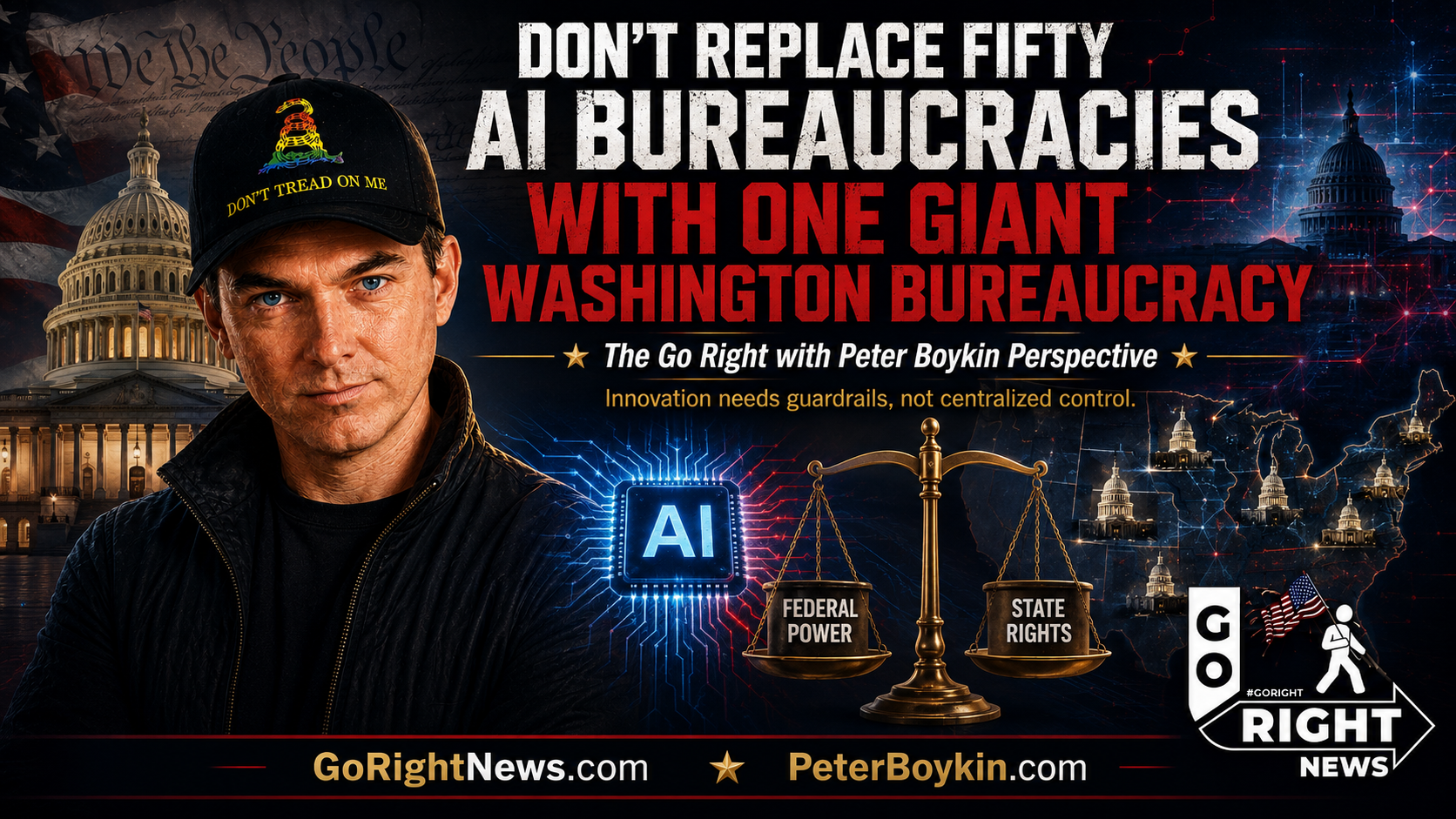
Don’t Trade Fifty AI Bureaucracies for One Giant Washington Bureaucracy
The Go Right with Peter Boykin Perspective
Artificial intelligence may be one of the most transformative technologies any of us will see in our lifetime, and I think conservatives need to resist the temptation to turn this into another simplistic argument where one side says regulate everything and the other side says regulate nothing.
Neither position is good enough.
President Trump is right that America needs to win the AI race.
I want the best artificial intelligence companies in the world built in the United States.
I want American entrepreneurs creating the next generation of technology.
I want American workers benefiting from increased productivity rather than watching the entire industry move overseas.
I want American military and intelligence agencies to maintain a technological advantage over China, Russia and every adversary that would gladly use artificial intelligence against us.
And I absolutely do not want the United States to regulate itself into second place while China builds.
Trump is also right about something else that many critics do not want to admit.
A 50-state regulatory patchwork can become a nightmare.
Imagine you are building an AI startup in North Carolina.
You have fifteen employees.
You have a good idea.
Maybe your company could become the next major American technology success story.
Then the lawyers arrive.
California has one standard.
Colorado has another.
New York has another.
Texas has another.
Ten other states have disclosure requirements.
Another state requires a safety report.
Another requires a different discrimination analysis.
Another creates a private lawsuit.
Another wants a registration process.
Suddenly you are not building artificial intelligence.
You are building a compliance department.
Google can afford that.
Microsoft can afford that.
Meta can afford that.
Amazon can afford that.
A small entrepreneur in Raleigh may not be able to.
That means badly designed regulation can actually protect Big Tech.
The biggest companies can absorb almost any regulatory cost.
Startups cannot.
So when Trump says a confusing patchwork can hurt American innovation, I think conservatives should listen.
That is a real problem.
But acknowledging the problem does not mean Washington automatically gets every power it wants.
This is where being a Constitutionalist for Liberty matters.
The answer to fifty potentially bad bureaucracies is not necessarily one enormous federal bureaucracy.
The answer to state overreach is not unlimited federal overreach.
And the answer to confusing state laws should not be giving every future president the ability to decide which state policies are acceptable based on the political preferences of the administration currently controlling Washington.
There are constitutional tools for dealing with bad state laws.
If a state AI law violates the First Amendment, challenge it.
If it violates equal protection, challenge it.
If federal law clearly preempts it, enforce federal law.
If the state improperly regulates interstate commerce, make that constitutional argument.
Then let an independent court decide.
That is not federal tyranny.
That is the constitutional system working the way it was designed.
But if Washington simply dislikes North Carolina’s policy choice, that is something different.
And conservatives should remember that states matter.
Federalism matters.
Local control matters.
We have spent decades saying that.
We say it about education.
We say it about land use.
We say it about policing.
We say it about healthcare.
We say it about firearms.
We say it about environmental policy.
We cannot suddenly decide federalism is obsolete because artificial intelligence is involved and a Republican president wants national uniformity.
The principle has to survive our own side.
I do not want California determining what every artificial intelligence system in North Carolina is allowed to say.
I do not want one heavily regulated state effectively writing national policy simply because technology companies decide it is easier to follow California’s rules everywhere.
That is a real danger.
But the reverse is also true.
I do not want Washington telling North Carolina that our elected legislature has no authority to protect people from AI fraud, deceptive automated decisions or irresponsible government use of artificial intelligence.
Take healthcare.
North Carolina’s HB 565 addresses the use of AI in insurance and Medicaid decisions.
That is not some abstract culture war.
Imagine an insurance company denying a treatment because an algorithm decided it was not medically necessary.
The patient asks why.
The doctor asks why.
Nobody can provide a meaningful answer because the company simply says the computer made the recommendation.
I do not want that.
Artificial intelligence can help doctors and insurers process enormous amounts of information.
That may improve healthcare.
But a machine should not become a shield government, or corporations use to avoid human accountability.
If North Carolina wants to say that AI cannot be the sole basis for certain healthcare decisions, I think Raleigh has a legitimate interest in making that rule.
The same principle applies when the government uses AI.
If a state agency uses artificial intelligence to determine who receives a benefit, who gets investigated or who gets flagged for some government action, citizens should know how that power is being exercised.
Government should never be able to say, “The algorithm decided,” and pretend nobody is responsible.
A machine does not take an oath to the Constitution.
Government officials do.
That accountability has to remain.
Children are another obvious example.
Trump’s own order recognizes a role for state child-safety protections.
Good.
States should not have to wait for Washington to act every time a new technology creates a threat involving children.
If somebody uses artificial intelligence to sexually exploit minors, facilitate fraud or impersonate children, state law enforcement should have tools available.
None of this requires building an enormous bureaucracy.
The goal should be targeted rules addressing actual harms.
And this is where Congress needs to stop hiding behind the executive branch.
Congress is missing from too many American policy fights.
The pattern is becoming predictable.
Congress does nothing.
A president gets frustrated.
The president signs an executive order.
Agencies stretch old statutes.
States respond with their own laws.
The Justice Department sues somebody.
Everybody ends up in federal court.
Then nine justices are expected to settle a policy question 535 elected members of Congress were unwilling to address.
That is backwards.
If artificial intelligence genuinely requires a national framework, Congress should write it.
Hold hearings.
Bring in the developers.
Bring in the startups.
Bring in cybersecurity experts.
Bring in parents.
Bring in states.
Bring in creators and copyright holders.
Bring in workers who are afraid their jobs may disappear.
Bring in companies using AI to create new jobs.
Bring in free-speech organizations.
Bring in civil liberties groups.
Bring in national-security officials.
Put everybody at the table.
Then answer the difficult questions.
Which AI rules truly need national uniformity?
Which rules should remain with the states?
When can an automated system make a consequential decision?
When is human review required?
How do we protect children?
How do we stop fraud?
How do we protect intellectual property without making AI development impossible?
How do we ensure startups can compete?
How do we protect the First Amendment?
And perhaps most importantly, how do we prevent government from using artificial intelligence as the next tool for controlling speech?
That last question worries me enormously.
Artificial intelligence is increasingly becoming the interface between Americans and information.
People already use AI to ask questions about politics.
History.
Religion.
Science.
Medicine.
Law.
News.
Public policy.
Imagine what happens if government develops the power to dictate what those systems are permitted to tell you.
I do not want California ordering an AI model to give progressive answers.
I do not want Texas ordering the same model to give conservative answers.
And I certainly do not want Washington developing a national Ministry of Artificial Truth.
Republicans may control Washington today.
They will not control Washington forever.
Power does not disappear when an administration leaves office.
It gets inherited.
That is something conservatives forget at our own peril.
Maybe Trump’s administration uses federal AI authority to prevent censorship today.
What happens when a future administration decides that every nationally approved AI model must follow federal standards concerning “misinformation”?
Or “equity”?
Or “public safety”?
Or “harmful speech”?
Those words can sound reasonable until government decides what they mean.
Then suddenly the national uniformity conservatives supported becomes the mechanism by which Washington decides what artificial intelligence is allowed to tell Americans.
I would rather prevent that concentration of power now than complain about it later.
That does not mean every state regulation should survive.
Some states will write terrible AI laws.
Some will overregulate.
Some will create ideological requirements.
Some will impose rules that are practically impossible for national companies to follow.
Challenge those laws.
Let courts examine them.
And where genuine national uniformity is necessary, let Congress preempt them through legislation.
That is what the Commerce Clause is for.
Congress can draw the line.
The president can enforce the law.
Courts can decide whether Congress and the president stayed within the Constitution.
States can govern the areas left to them.
That is federalism.
It is messy.
It is slower than executive government.
It produces arguments.
That is intentional.
The Constitution divides power because concentrated power is efficient right up until somebody abuses it.
There is another conservative argument for state experimentation that should not be lost.
We do not actually know the perfect way to regulate artificial intelligence.
Nobody does.
This technology is developing too quickly.
A rule lawmakers write today may look ridiculous three years from now.
That is one reason laboratories of democracy matter.
Let one state experiment with a transparency rule.
Let another try a different approach.
See what works.
See what fails.
Let businesses vote with their feet.
Let lawmakers learn from other states.
Do not make every bad regulatory experiment a national mistake.
At the same time, we have to recognize that AI is different from many traditional industries because digital products cross borders instantly.
That means some national standards probably are necessary.
Fine.
Create the national baseline.
Protect free speech.
Protect competition.
Protect innovators.
Protect consumers from fraud.
Protect children.
Protect copyright where appropriate.
Protect national security.
Then preserve space for states to govern areas where state authority still makes sense.
That is the balance.
And I think Trump’s pressure on this issue could ultimately produce something positive if it forces Congress to finally do its job.
The administration has correctly identified a serious problem.
America cannot function with 50 wildly conflicting AI rulebooks governing the same national technology.
The next question is whether we solve that problem constitutionally.
I want American AI dominance.
I want fewer unnecessary regulations.
I want startups competing with trillion-dollar corporations.
I want China looking at America’s technology sector and realizing it cannot catch us.
But I also want divided government power.
I want constitutional checks.
I want states capable of protecting their residents where they possess legitimate authority.
I want courts stopping unconstitutional state laws.
I want Congress, not executive agencies, writing the national rules.
And I want government kept as far away as possible from deciding what lawful political ideas artificial intelligence is allowed to express.
Artificial intelligence may change almost everything about how we work, communicate and live.
It should not change the basic constitutional lesson the Founders understood.
Power needs limits.
Power needs competition.
Power needs accountability.
And power should never be concentrated merely because centralized control is more convenient.
Build the AI.
Win the technology race.
Protect American innovation.
Stop genuine abuses.
Create national standards where national standards are actually necessary.
Let states experiment where federalism still makes sense.
And never trade fifty AI bureaucracies for one giant Washington bureaucracy simply because Washington promises that its bureaucracy will be smarter.
Let’s #GoRight, not blindly right, but constitutionally right.
President Trump is pushing toward a uniform national artificial intelligence framework while the Justice Department challenges state AI regulations and states continue writing their own rules. Colorado has already replaced its original AI law after a major federal-state confrontation, while North Carolina is considering AI protections involving healthcare, insurance and other consequential decisions. The constitutional fight is increasingly clear: America may need national AI standards, but Congress, the states and the executive branch still have very different constitutional roles.
#GoRight #GoRightNews #PeterBoykin #ConstitutionalistForLiberty #DonaldTrump #PresidentTrump #ArtificialIntelligence #AI #AIRegulation #Federalism #StatesRights #FreeSpeech #FirstAmendment #NorthCarolina #NCPolitics #NCGA #Technology #Innovation #BigTech #Congress #DOJ #ConsumerProtection #LimitedGovernment #Constitution #China #AmericanInnovation
Sources
The White House, Ensuring a National Policy Framework for Artificial Intelligence
Executive Order 14365, signed December 11, 2025, establishing the administration’s national AI policy and directing creation of the AI Litigation Task Force. (The White House)
Read Executive Order 14365
The White House, President Donald J. Trump Unveils National AI Legislative Framework
The administration’s March 20, 2026 proposal asking Congress to establish uniform national AI policies involving children, intellectual property, speech, innovation, energy and the workforce. (The White House)
Read the White House AI legislative framework
U.S. Department of Justice, Justice Department Intervenes in xAI Lawsuit Challenging Colorado’s Algorithmic Discrimination Law
DOJ’s official explanation of its Fourteenth Amendment challenge to Colorado’s original AI statute. (Department of Justice)
Read the Justice Department announcement
Colorado General Assembly, SB 26-189 Automated Decision-Making Technology
Official legislative record showing Colorado repealed and reenacted its earlier AI framework and that Governor Jared Polis signed the replacement law on May 14, 2026. (Colorado General Assembly)
Read Colorado SB 26-189
Reuters, Who Governs AI? The Federal Government’s Challenge to State Regulation
August 12, 2026 analysis of the expanding federal-state conflict and the administration’s efforts to challenge state AI laws. (Reuters)
Read the Reuters analysis
North Carolina General Assembly, House Bill 565: Limit Use of AI Medicaid/Commercial Insurance
Official bill history showing the legislation passed the House 110-1 and was referred to Senate Rules after further committee revisions. (North Carolina General Assembly)
North Carolina HB 565
North Carolina General Assembly, House Bill 1161: Omnibus Artificial Intelligence Protections
Official legislative page for North Carolina’s broader AI proposal involving areas including education, employment, elections, courts and insurance. (North Carolina General Assembly)
North Carolina HB 1161
North Carolina General Assembly, Artificial Intelligence Legislation
Official list of AI-related proposals before the General Assembly. (North Carolina General Assembly)
North Carolina AI legislation list
Congress, American Artificial Intelligence Leadership and Uniformity Act, H.R. 5388
Introduced legislation proposing a national AI framework and temporary preemption of certain state AI restrictions affecting interstate commerce. The measure has not become law. (Congress.gov)
Read H.R. 5388
Congress, States’ Right to Regulate AI Act, S. 3557
Competing Senate legislation that would prohibit federal funds from being used to implement Trump’s state AI preemption executive order. It remains in committee. (Congress.gov)
Read S. 3557
Shared by #GoRightNews
gorightnc.com/

Call to Action
For daily commentary grounded in liberty, justice, constitutional values, and common sense, visit
gorightnc.com/.
Subscribe to Go Right with Peter Boykin on
Rumble,
YouTube,
Spotify,
Apple Podcasts,
Amazon Music,
and
Spreaker.
Follow #GoRight with Peter Boykin across the major platforms.
Support the Platform
Go Right News is independent media. If you support commentary that holds power accountable and defends constitutional liberty, consider helping keep the platform going.
Donate through
Cash App $GoRightNews
or visit
gorightnc.com/ Donations.
Stay informed. Stay free. It is time to #GoRight.
#GoRight: More Than Politics, A Way of Life
At Go Right News, we know many people judge the headline before reading the facts. That is why we focus on context, accountability, and constitutional principles instead of outrage for outrage’s sake.
We lean right, but we are not here to defend hypocrisy, extremism, or double standards from any side. We stand for truth, liberty, personal responsibility, and the rights of We the People.
#GoRight is not just about politics. It means doing right, thinking right, being right, and voting right. It is a call to build, not destroy. It is about working toward a better future together.

Official Links
Web:
gorightnc.com/ |GoRightNC.com |PeterBoykin.com |GaysForLiberty.org
Video and Podcast:
Rumble |YouTube |Spreaker |Spotify |Apple Podcasts |Amazon Music
Social:
Facebook |X |Telegram |Instagram |Reddit
Kick:
PeterBoykin |GoRightNews |LuckyNLoose


Help Keep Go Right News Independent
Each month, Go Right News spends hundreds of dollars and many hours running this site, producing content, and keeping the podcast alive without corporate control. If you like the content, please consider supporting the platform.
#GoRightNews #GoRight #PeterBoykin #ConstitutionalistForLiberty #ConservativeVoice #LibertyPodcast #IndependentMedia #CitizenJournalist #ConservativeCommentary #ConstitutionalTalk #FreedomOfSpeech #AmericaFirst #NorthCarolina #NCPOL #NCPolitics #BoykinForNC #GoRightNC #GaysForLiberty
Shared by #GoRightNews
https://gorightnc.com/